Estimating screen assists
We estimate screen assists by following the scoring shot and measuring where offensive teammates lie relative to the puck and defending goaltender over a short interval around release. Public NHL goal-replay tracking supplies the positions and timing, while independent Clear Sight Analytics (CSA) annotations provide a reference for selecting and evaluating the detector. The attribution rule can accommodate both sustained alignment and brief crossings. Because the tracks locate shoulder sensors and omit body orientation and the goaltender’s actual view, we also assess how positional assumptions and estimated release timing affect the resulting credits.
Definition and counting rules
We award one estimated screen assist to each qualifying offensive teammate on a goal, excluding the credited scorer; multiple teammates can qualify, including official assist recipients. Empty-net goals and shootouts are excluded. A teammate may qualify through sustained alignment or a brief crossing whose geometry and timing resemble annotated screens. The conservative threshold is selected using precision-weighted F0.5, while the broader threshold uses F1 and is constrained to include every conservative credit. These settings produce different measured precision and recall. Their paired totals describe alternative attribution thresholds and do not form a confidence interval.
Identifying the scoring shot
Attribution begins with reconstructing the scoring attempt from short replay sequences sampled at 10 Hz. We follow NHL player identifiers as tracking slots change and rotate the coordinates so the attacking goal is at x = 89 ft. The final recorded frame need not mark the goal, so possible goal-plane crossings provide arrivals from which we trace the puck backward to estimate release. Ordinary-shot estimates use movement toward goal, separation from the scorer, and agreement with the official shot location. Tips and deflections require tracing the incoming flight and checking the scorer near the final touch. For rebounds, the scoring attempt determines the analysis window; any earlier screen must also fall within that window to receive credit.
The sampling interval and absence of puck-touch annotations limit the precision of this reconstruction. A clip remains unevaluable when timing cannot be resolved, critical positions are missing, or the goalie cannot be identified, and we reject tracking gaps longer than 0.21 s within the critical interval. To assess the effect of release uncertainty on attribution, we also shift the estimated release by ±0.10 s.
Sightline geometry
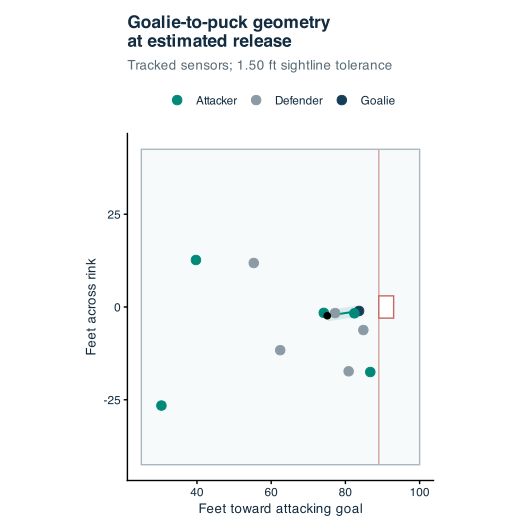
The finite segment joining the goalie and puck defines the geometry used for attribution. For their tracked positions g and p and a potential screener’s position s, the projection u locates the player along the segment and d measures perpendicular separation. Obstruction is evaluated only when the player lies strictly between the endpoints and the segment exceeds 2 ft.
d = ‖(s − g) − u(p − g)‖ when 0 < u < 1
We summarize the geometry over three intervals: the 0.50 s before release, a band from −0.20 to +0.10 s around release, and the puck’s flight toward the goalie. After release, the windows end at arrival and exclude puck positions more than 1 ft beyond the goalie’s longitudinal position. The resulting features capture separation, total and continuous obstruction duration, goalie proximity, crossings, and the interval since the last obstruction before release. A geometric baseline combines alignment and duration with this estimated reacquisition time.
Positional and timing uncertainty
A player’s tracked point comes from a right-shoulder sensor, placing it away from the body center and, for goaltenders, the eyes. Orientation, gaze, stance and puck height are unobserved, and skating direction cannot supply them: a player may move backward or sideways, or remain stationary. We therefore use the segment as a two-dimensional proxy for possible visual obstruction.
The primary effective tolerance is 1.50 ft. Alternatives of 1.00 and 2.00 ft change the obstruction features to examine sensitivity to body extent and sensor displacement while leaving the fitted detector and thresholds fixed. These scenarios explore specific positional assumptions; they neither cover every possible posture nor establish whether the goaltender loses sight of the puck.
Each example opens a selected player’s list of credited goals with the example replay selected. Playback and frame controls allow inspection around release, and the Player names control adjusts the displayed labels. The shaded band appears automatically when the puck and goaltender positions are valid and the sightline is active, illustrating the 1.50 ft effective tolerance.
Reference annotations and evaluation
The private attribution reference comes from reviewed, quality-controlled CSA records matched to public goals. A match must agree on the NHL game, scorer, teams, goalie and period. Matching event identifiers permit a clock difference of at most one second; without that match, we require a unique exact clock-and-scorer match that passes the same contextual checks. We remove duplicate participant memberships before evaluating attribution.
Reference labels depend on explicit classifications. Positive events require an offensive-screen, mixed-screen, one-timer/screen or screen/deflection classification together with a named offensive teammate other than the scorer; negative events require a clear-sight or defensive-only classification with no offensive teammate recorded. Screen-on-pass cases and screen-classified events without a named offensive teammate are excluded. Within events with recorded participants, the list supplies the attribution reference under the assumption that it is complete. A named participant without usable tracking remains an unrecovered positive.
We use 2023–24 for development, 2024–25 for detector and threshold selection, and the reserved 2025–26 season for evaluation. The geometric baseline and ridge logistic regression are compared on player-level average precision using public tracking features, with the baseline preferred in a tie. Player identity and CSA scoring probabilities are excluded from the predictors. Evaluation reports goal detection and player attribution separately because a detected screened goal can still be assigned to the wrong teammate. The calibration results apply to this selected reference population.
Counts and rate denominators
Screen assists per 60 min = 3,600 × credits / ice-time seconds
The same season, competition, team and October 19, 2026 cutoff apply to credits, appearances and ice time. A traded player’s records follow the team represented in each game, and players with zero detected credits remain eligible. Counts have no exposure minimum. For rates, the defaults are 25 games or 250 minutes for completed seasons and the combined all-seasons view, and five games or 60 minutes for the ongoing season; playoff-only rankings start without a minimum. Readers can adjust these values, although rates always require positive exposure.
Official appearances and ice time include games with missing or unevaluable replays, while credits come only from goals that can be evaluated. We do not impute replacement credits, so missing tracking can depress the rates. Differences in playing roles, teammates and team shooting volume also shape screening opportunities; adjustment for official exposure alone cannot isolate causal player value.
Replay availability and evaluable goals
Coverage comprises 2023–24 through 2025–26 and completed 2026–27 games dated through October 19, 2026. Before tracking-quality exclusions, stored replays are available for 99.22% of official non-shootout goals in 2023–24. The table separates goals with usable shot intervals from empty-net goals and the remaining unevaluable cases.
| Season | Official goals | Evaluated | Empty net | Unevaluable |
|---|
Data and reproducibility
Public materials in the repository include the R analysis code, detector parameters, goal–player credits, official player-game exposure, short replay segments and aggregate findings. Together, they reproduce the ranking arithmetic, figures and paper, with the package revision and data snapshot recorded in the input provenance. Full tracking caches remain local. Private CSA records and event-level reference labels are not distributed, and re-estimating the CSA-dependent models requires authorized database access.